The Unlikely Reformer by Matthew P. Fink
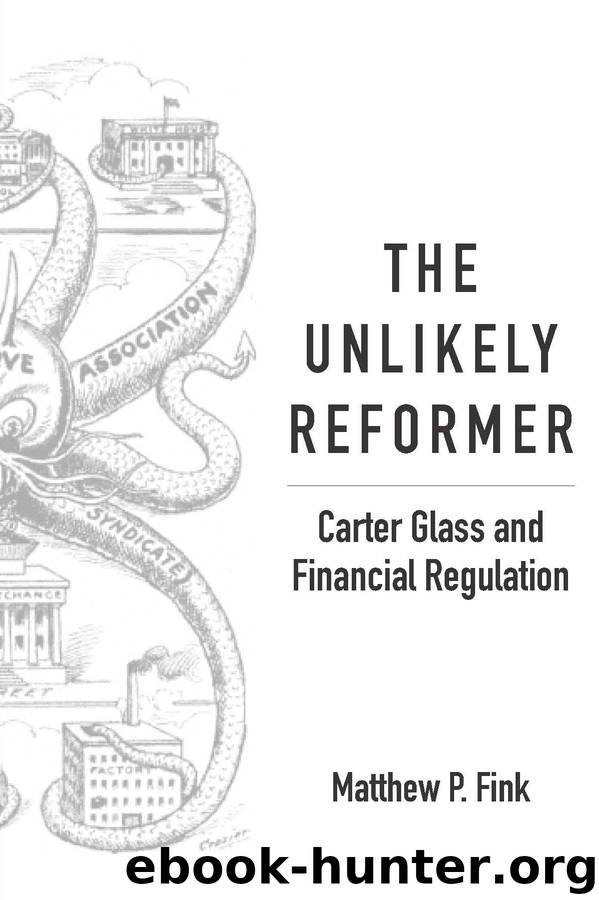
Author:Matthew P. Fink
Language: eng
Format: epub
Publisher: George Mason University
Published: 2019-03-21T21:20:52+00:00
Subsequent Views of the Glass-Steagall Act
The ink was barely dry on the Glass-Steagall Act when supporters of the New Deal began hailing the act as a New Deal reform. In 1933, J. George Frederick termed the Glass-Steagall Act “the last of the ‘New Deal’ measures” enacted during the First Hundred Days of the Roosevelt Administration. In 1934, Roger W. Babson stated that although bankers did not believe that Roosevelt was in earnest when he spoke about “the money changers in the temple,” the Glass-Steagall Act made them “realize it now.” President Roosevelt himself, despite his adamant opposition to deposit insurance and his lukewarm support for the bill as a whole, later claimed credit for the legislation.31
Glass also lived to see many anti–New Dealers praise the separation provisions he had crafted. In 1934, James P. Warburg, an investment banker who first supported the New Deal but later broke with it, wrote: “The Glass-Steagall Bill … contains much that is good. It provided at last the much-needed separation of the investment business from the commercial banking business.”
In 1940, Samuel Pettingill, a former Democratic congressman, warned that the New Deal was moving the nation toward National Socialism and Marxism, but that there were a few positive developments, including “the divorcement of commercial and investment banking.”
Perhaps the most interesting case was that of John T. Flynn. In 1933, Flynn, then a muckraking columnist for the liberal New Republic magazine, identified the “two good features” of the Glass-Steagall Act: “the divorcement of affiliates of banks within a year and the attempt to compel private bankers to separate their commercial-banking and investment-banking business.” Flynn went on to become a vociferous anti–New Dealer and a rabid Roosevelt-hater. However, in his 1955 book, The Decline of the American Republic, Flynn still excoriated bank security affiliates and implicitly endorsed Glass-Steagall’s separation provisions.32
On the other hand, during Glass’s lifetime, there were those who criticized the separation provisions. In 1938, Professor George W. Edwards, chairman of the Department of Economics at New York’s City College, stated that “public interest would have been better served had Congress decided to supervise rather than divorce the capital market from the commercial banking system.” Edwards went on to predict that Congress would have “the inevitable task of retracing its course in the years which are yet to come.”33 Edwards’s prediction came true in 1999 when Congress repealed the separation provisions.
Download
This site does not store any files on its server. We only index and link to content provided by other sites. Please contact the content providers to delete copyright contents if any and email us, we'll remove relevant links or contents immediately.
International Integration of the Brazilian Economy by Elias C. Grivoyannis(111326)
The Radium Girls by Kate Moore(12097)
Turbulence by E. J. Noyes(8133)
Nudge - Improving Decisions about Health, Wealth, and Happiness by Thaler Sunstein(7765)
The Black Swan by Nassim Nicholas Taleb(7202)
Rich Dad Poor Dad by Robert T. Kiyosaki(6733)
Pioneering Portfolio Management by David F. Swensen(6345)
Man-made Catastrophes and Risk Information Concealment by Dmitry Chernov & Didier Sornette(6145)
Zero to One by Peter Thiel(5876)
Secrecy World by Jake Bernstein(4807)
Millionaire: The Philanderer, Gambler, and Duelist Who Invented Modern Finance by Janet Gleeson(4541)
The Age of Surveillance Capitalism by Shoshana Zuboff(4359)
Skin in the Game by Nassim Nicholas Taleb(4312)
The Money Culture by Michael Lewis(4269)
Bullshit Jobs by David Graeber(4256)
Skin in the Game: Hidden Asymmetries in Daily Life by Nassim Nicholas Taleb(4053)
The Dhandho Investor by Mohnish Pabrai(3829)
The Wisdom of Finance by Mihir Desai(3798)
Blockchain Basics by Daniel Drescher(3644)
